Aggregates Testing Services & Laboratory
Professional laboratory testing to evaluate coarse and fine concrete aggregates, river sand, M-sand, and road base gravel. Accurate testing for sieve analysis, crushing value (ACV), impact value (AIV), abrasion, flakiness, and water absorption.

CIVIL & GRANULAR MATERIAL TESTING
Aggregates Testing Services & Laboratory
Professional laboratory testing to evaluate coarse and fine concrete aggregates, river sand, M-sand, and road base gravel. Accurate testing for sieve analysis, crushing value (ACV), impact value (AIV), abrasion, flakiness, and water absorption.
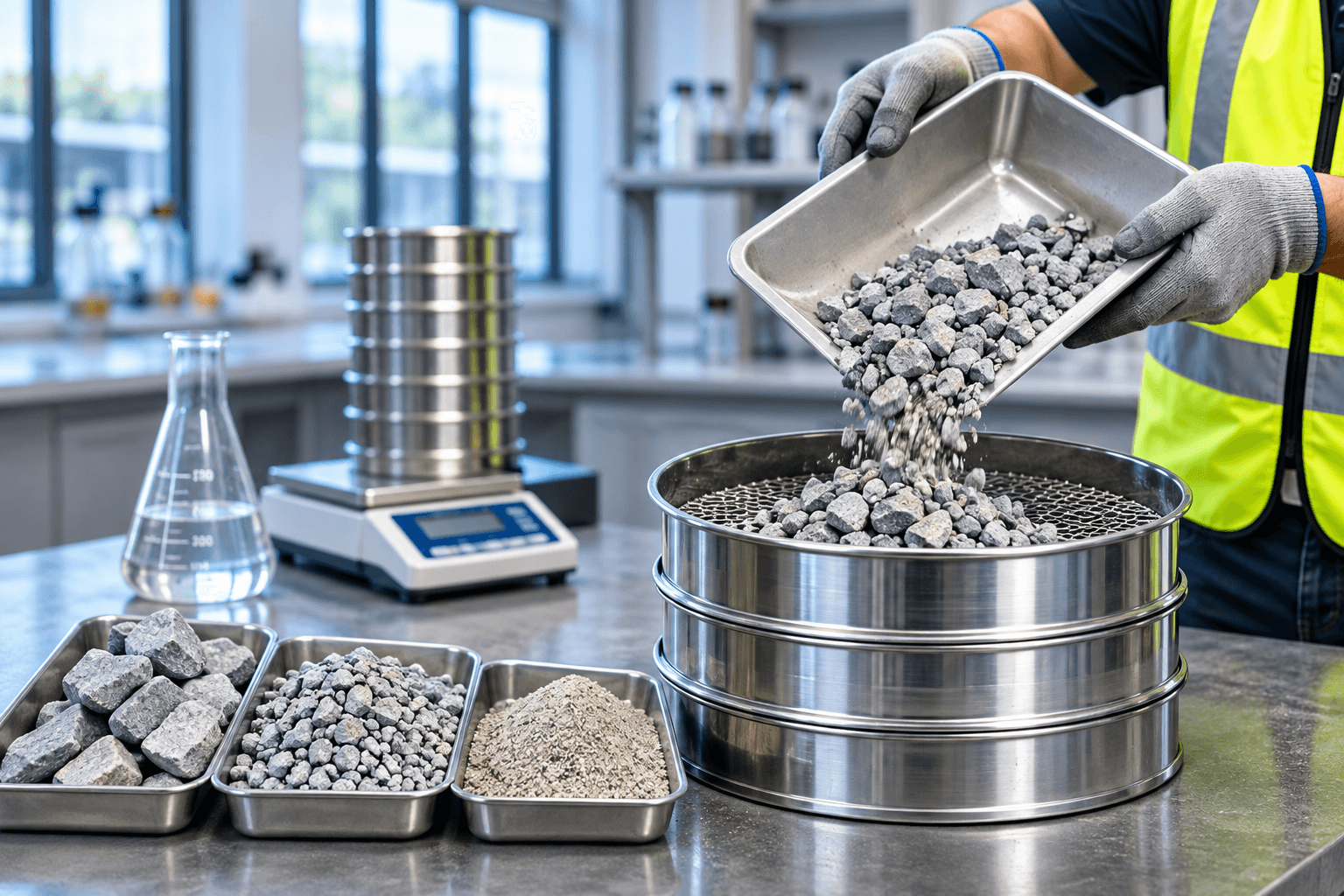
Professional Aggregates Quality Evaluation Laboratory
Our laboratory provides reliable aggregates testing services to evaluate the physical, mechanical, and geological characteristics of natural gravel, crushed stone, manufactured sand (M-sand), and road base materials used across infrastructure and building projects.
Aggregates make up over 70% of concrete volume, making their mechanical strength, gradation, and shape critical to structural durability. We conduct standardized tests including sieve analysis, crushing value, impact value, Los Angeles abrasion, flakiness index, and sulfate soundness as per published standard methods, helping contractors and quarry operators verify compliance before batching.
Reliable
Testing Services
Advanced
Testing Equipment
Quality
Test Reports
Our Comprehensive Aggregates Testing Services
Standardized physical, mechanical, and grading evaluations performed under controlled laboratory conditions.
Sieve Analysis & Particle Grading
Determines particle size distribution for coarse and fine aggregates using calibrated mechanical sieve shakers. Identifies sand grading zones (Zones I to IV) and coarse aggregate gradation as per standard sieve analysis procedures.
Aggregate Crushing Value (ACV)
Evaluates mechanical resistance to crushing under a progressively applied compressive load of 400 kN over 10 minutes (limit ≤ 30% for wearing courses; ≤ 45% for other structures) under standard mechanical crushing procedures.
Aggregate Impact Value (AIV)
Measures aggregate toughness and resistance to sudden shock using a standard 13.5–14.0 kg hammer falling through 380 mm for 15 blows. Crucial for highway wearing courses and pavements under standard aggregate impact test protocols.
Los Angeles Abrasion Value (LAA)
Assesses resistance to surface friction, rolling wear, and mechanical attrition in a rotating drum with specified steel charge balls. Essential quality control for road surfacing under standard rotating drum abrasion methods.
Flakiness & Elongation Indices
Quantifies flaky (thickness < 0.6 mean size) and elongated (length > 1.8 mean size) particles using standard gauges to prevent honeycombed, weak concrete matrices using standard thickness and length gauges.
Specific Gravity & Water Absorption
Measures apparent specific gravity and 24-hour water absorption using wire basket immersion methods. Crucial for accurate batch water adjustments in concrete mix design using wire basket immersion test methods.
Soundness Test (Sulfate Durability)
Evaluates weathering resistance through 5 cycles of immersion in saturated sodium sulfate (Na₂SO₄) or magnesium sulfate (MgSO₄) followed by oven drying under standard accelerated chemical soundness procedures.
Silt, Clay & Decantation Test
Measures clay lumps, organic matter, and fine particles passing 75 microns by the decantation method to ensure optimal cement-paste bond strength under standard decantation and silt content procedures.
10% Fines Value (TFV)
Determines the load required to produce 10% fines from aggregate fractions, providing a reliable measure of crushing resistance for weaker or porous stone varieties using calibrated compressive loading procedures.

Aggregates Testing for Concrete, Highways & Infrastructure
Our aggregate testing services support high-rise residential casting, expressway asphalt wearing courses, ready-mix concrete batching plants, and precast manufacturing. Independent testing ensures that granular materials possess proper gradation, impact toughness, and volume stability for long-lasting structural performance.
Structural Concrete
Foundations & Slabs
Highway Pavements
Asphalt & Base Courses
Ready-Mix Concrete
Grading Zone Control
Precast & Pavers
High Density Blocks
Our Aggregates Testing Process
Sampling & Intake
Inspection of sealed sample bags, batch identification, and laboratory intake logging.
Quartering & Drying
Sample reduction using riffle splitters and oven drying to constant mass for consistent specimens.
Sieve & Particle Sizing
Grading curves generated through calibrated mechanical sieve shaker analysis across standard nests.
Mechanical Crushing & Impact
Crushing under 400 kN load, dynamic impact blows, and Los Angeles drum abrasion tests.
Report Issuance
Verification of parameters against standard technical acceptance limits with verified test reports issued.
Sample Submission Guidelines for Aggregates Testing
Follow these technical guidelines when preparing and dispatching aggregate samples to our laboratory facility in Noida.
Sample Quantity
Submit 30 kg to 50 kg for coarse aggregates (10 mm, 20 mm, 40 mm) and 15 kg to 20 kg for fine aggregates (river sand or M-sand) to perform complete physical and mechanical testing.
Representative Sampling
Sample increments should be gathered from multiple stockpile points (top, middle, base) to avoid segregated zones, and mixed thoroughly before bagging.
Durable Packaging
Pack in clean, heavy-duty woven polypropylene bags with secure ties. Clearly label each bag with source quarry, nominal size fraction, and project lot number.
Intake & Delivery
Deliver directly to our laboratory facility at Plot No. 79, Sector 155, Noida (201310), accompanied by a test requisition form detailing required standard parameters.
Why Choose MQTL for Aggregates Testing?
Accurate, standard-referenced physical and mechanical evaluations backed by experienced materials testing engineers.
Calibrated Equipment
Testing executed on automated compression rigs, standard impact testers, mechanical sieve shakers, and Los Angeles abrasion machines calibrated to national standards.
Documented SOPs
Every test method references recognized published standard engineering procedures and specifications.
Verified Test Certificates
Standard mechanical and physical test certificates issued promptly following laboratory evaluation.
Engineering Expertise
Direct consultation with qualified civil materials engineers to interpret grading curves and mix design parameters.
Need Reliable Aggregates Quality Testing?
Connect with our testing experts in Noida to schedule aggregate evaluation, request customized batch testing, or obtain verified laboratory test reports.
Frequently Asked Questions About Aggregates Testing
Technical guidance on crushing value limits, sieve analysis, flakiness indices, and sample handling.